

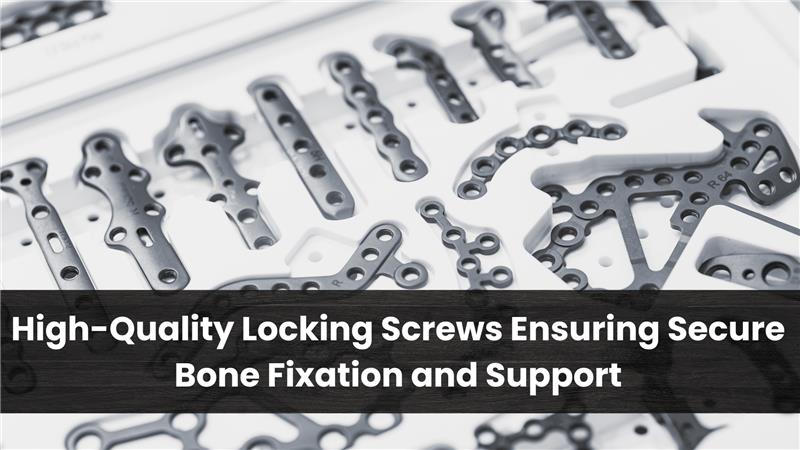
In the ever-advancing world of orthopaedic trauma, internal fixation technologies have undergone dramatic refinement. Among these, the role of locking screws has risen to prominence. When used appropriately, locking screws provide surgeons with enhanced stability, predictable performance and support in challenging fracture-environments. At aocare.in, we believe in offering high-quality fixation hardware that meets the demands of modern fracture care. In this blog, we explore what locking screws are, why they matter, their design and biomechanics, clinical indications, key quality criteria for purchasing, how they differ from non-locking screws, potential complications and how to mitigate them — all the way to how a trusted supplier like AO Care (on aocare.in) can help you with quality products and service.
What are Locking Screws?
A “locking screw” is a special type of bone‐screw used in conjunction with a “locking plate” (or other implant) such that the screw head mechanically locks into the plate hole (or construct) rather than relying solely on friction between plate and bone.
In more detail:
- The plate is manufactured with threaded or otherwise form-fit holes that engage the screw-head.
- The screw head has a corresponding thread or geometry so when it is tightened it “locks” into the plate.
- Because of that locked head‐to‐plate interface, the construct becomes a fixed-angle device, meaning the screw enters the bone and is locked relative to the plate rather than simply pulling the plate against the bone.
This fixed-angle behaviour distinguishes locking screw constructs from traditional non-locking systems (where screws compress the plate to bone or rely on friction).
Therefore, when we say “Locking Screws” for your bone fixation system, we mean screws specifically designed to integrate with a locking plate or system and achieve a more stable fixation geometry.
Why Use Locking Screws? The Clinical Rationale
Locking screws bring a number of biomechanical and clinical advantages which make them highly valuable in many orthopaedic scenarios. Some of the key reasons include:
1. Enhanced construct stability
Because the screw is locked into the plate, the plate‐bone interface does not have to rely on intimate plate contact with the bone. This means the construct is less dependent on bone quality and plate fit.
In osteoporotic bone, comminuted fractures, peri‐articular zones or where soft tissue coverage is limited, this is especially advantageous. auxein.com+1
2. Fixed‐angle behaviour
The locked interface prevents toggling of the screw relative to the plate, reducing micro-motion at the screw/plate/bone junction and thus helps in maintaining reduction and alignment.
3. Preservation of periosteal blood supply
Since plate compression to the bone is not required (or is minimal), the risk of stripping periosteum or interfering with bone perfusion is reduced.
4. Better performance in compromised bone
In fractures with poor bone quality (e.g., osteoporotic bone), or short metaphyseal fragments where screw purchase is limited, locking screws can make the difference between success and failure.
5. Versatility in minimally invasive techniques
Locking screw systems often allow for bridging techniques, minimal soft‐tissue disruption and indirect reduction strategies – helping preserve biology while maintaining stability.
Given these benefits, the choice of high‐quality locking screws becomes critical for outcomes.
Understanding the Design & Biomechanics
To appreciate how locking screws deliver their advantages, it is useful to review their design features and biomechanics.
Design Features
Locking screws differ from standard screws in several specific ways. Some salient features:
- Threaded head interface: The screw head has male threads (or equivalent mechanism) which engage the female threads (or compatible geometry) of the plate hole. This engagement locks the screw head to the plate.
- Fixed‐angle orientation: Once engaged, the screw becomes fixed relative to the plate, creating an angle between plate and screw which resists off‐axis loads.
- Shaft and tip design: Depending on the manufacturer and application, locking screws may be fully threaded, partially threaded, self‐tapping, self‐drilling, cannulated, or designed for variable‐angle insertion.
- Material: Most locking screws are manufactured from high‐grade stainless steel (e.g. 316L) or titanium alloys (e.g. Ti-6Al-4V) to ensure strength, biocompatibility and corrosion resistance.
- Length and diameter options: For example, locking cortical screws may come in a wide range of lengths (6 mm to 120 mm) and diameters, suited for different plate systems and anatomical sites.
Biomechanics
How do these design features translate into biomechanical advantages?
- Load distribution: The fixed‐angle construct distributes load across the screw–plate–bone system rather than relying purely on friction or compression between plate and bone.
- Reduced risk of screw loosening: Because the head is locked to the plate, the interface does not rely on screw‐bone friction alone; thus micro‐motion (which can lead to screw back‐out) is minimized.
- Independence from perfect plate‐bone contact: As the plate does not need to be tightly compressed to bone, the surgeon has more flexibility in plate placement (beneficial in soft‐tissue compromised or peri-articular zones).
- Better performance in short segments or fragments: In short metaphyseal segments where only a few screws may be placed, the locking screws act as mini‐blade plates, enhancing fixation despite limited bone stock.
Together, these factors contribute to stable fixation and thus promote reliable bone healing, provided other biological factors are addressed.
Indications & Clinical Applications
When should surgeons and fixation teams consider using locking screws? Here are typical scenarios and considerations.
Common Indications
- Fractures in osteoporotic bone or with poor bone quality (locking screws help compensate for compromised screw purchase).
- Comminuted fractures or metaphyseal fractures with multiple fragments where conventional screw purchase is less reliable.
- Peri-articular fractures (near joints) where angular stability is critical to maintain alignment and reduce secondary collapse.
- Short metaphyseal fragments where traditional plate fixation may have limited screw purchase.
- Minimally invasive plating techniques (MIPO) where soft tissue preservation is important and plate-bone compression may be sub-optimal.
- Cases where soft tissue compromise, peri-articular comminution or bone loss make traditional plating more challenging.
Clinical Example
Consider a proximal humerus fracture in an elderly patient with osteoporotic bone. Using a locking plate and locking screws helps maintain alignment of fracture fragments, counters varus collapse, and avoids extensive stripping of periosteum. Indeed, studies in proximal humerus locking plate systems show intra-articular screw penetration, varus collapse and other complications are non‐trivial.
In another scenario, a distal femur peri-articular fracture with comminution and metaphyseal bone loss may benefit from a locking plate/locking screw combination, because the fixed‐angle construct allows the interplay of plate, screws and bone fragments to behave as an internal fixator rather than simply compressing the plate to bone.
Surgeon & Purchaser Considerations
- Fracture pattern: Is there comminution, metaphyseal extension, bone loss?
- Bone quality: Osteoporotic bone may benefit more from locking constructs.
- Soft tissue condition: If minimal exposure or MIPO is planned, locking screws help.
- Cost vs benefit: Locking systems may be more expensive, but their value in challenging scenarios may outweigh cost.
- Hardware inventory and instrument system: Do you have the correct drill guides, torque screwdrivers, plate systems to support the locking screws?
At AO Care, we supply locking screw systems optimized for these purposes with full instrumentation support, backed by testing and quality assurance.
Key Quality Criteria When Choosing Locking Screws
When selecting locking screws for purchase (for hospitals, trauma centres, orthopaedic units), the following factors are essential to ensure the screws you use deliver secure fixation and support.
1. Manufacturing materials & certification
- Ensure screws are made from medical-grade stainless steel or titanium alloy (Ti-6Al-4V) and are compliant with relevant international standards (ISO, CE mark, or equivalent).
- Traceability of material batches, corrosion resistance, fatigue testing and biocompatibility must be demonstrable.
2. Precision of thread engagement (head and plate)
- The interface between screw head and plate must provide reliable locking (i.e., minimal head-to-plate micro-motion).
- Thread geometry must be precise: male/female threads must match, and the risk of cross‐threading or wear must be minimized. For instance, locking cortical screws feature male threads on the screw head engaging female threads in the plate hole.
3. Variety of sizes & compatibility
- The system should offer a range of diameters and lengths (e.g., 2 mm, 2.4 mm, 3.5 mm, 5 mm etc) depending on plate size and anatomical site.
- Screws should be compatible with the plate system: e.g., locking plate holes should accept the locking screw head geometry.
- Availability of specialized screws: self‐tapping, self‐drilling, cannulated, variable-angle locking screws (if required) for complex anatomies.
4. Instrumentation and surgical workflow
- Availability of matched drill guides, depth gauges, torque limiting screwdrivers, countersinks, sleeves, etc. For example, locking systems often require specific drill bits or sleeves to ensure correct screw insertion.
- Clearly labelled instrumentation to ensure correct depth, correct angle insertion and to prevent over‐drilling.
5. Proven biomechanical performance
- Prefer systems with published biomechanical data or independent testing showing performance versus non-locking systems (e.g., improved pull-out resistance, reduced micro-motion, fixed‐angle stability). For example, locking plate/screw systems have been shown to provide more stable fixation than conventional systems.
6. Regulatory compliance and quality assurance
- Ensure the manufacturer follows ISO 13485 (for medical device quality management) or equivalent; that the screws are sterilizable, have proper packaging, batch control, and are licensed for orthopaedic use in your region (e.g., India’s CDSCO, CE, US FDA if applicable).
- The supplier (like AO Care) should provide documentation: CE certificates, material certificates, traceability.
7. Cost vs value and service support
- While locking screws and associated plate systems may cost more than conventional non‐locking systems, the improved outcomes in challenging cases may justify the cost.
- Also check the after‐sales service: instrument servicing, technical support, surgical training, inventory management, availability of spare components.
8. Sterility, packaging and logistics
- Screws must be supplied sterile, in clearly labelled, secure packaging.
- Ensure the packaging matches hospital protocols and international standards.
- The supplier should ensure proper supply chain, storage conditions, expiry monitoring.
At aocare.in, our locking screw systems meet these quality criteria: we offer certified materials, full instrumentation kits, compatibility across trauma plate systems, and responsive technical support.
Locking Screws vs Non-Locking Screws – A Comparative Overview
To clarify the difference and help purchasers decide when to adopt locking screws, here is a comparison.
In summary: non-locking screws remain perfectly appropriate for many straightforward fracture scenarios (good bone, simple geometry). However, locking screws bring important advantages in more challenging settings – which is why quality locking screws are essential in modern trauma fixation.
Potential Complications & How to Mitigate Them
Even the best locking screw systems are not without potential complications. Understanding these and how to avoid them is key to good outcomes.
Common complications
- Screw penetration of articular surfaces: Especially near joints (e.g., proximal humerus). For instance, in locking plate fixation of proximal humerus fractures, intra-articular screw penetration was reported in ~9.5% of cases in one review.
- Varus collapse or secondary displacement: Even with locking screws, loss of alignment can occur if support screws (e.g., inferomedial humeral head screws) are not placed.
- Poor plate/screw positioning or over-drilling: Since the locking screw head locks into the plate hole, over-drilling near the plate or improper insertion technique may compromise locking mechanism.
- Hardware failure (loosening, breakage): Though reduced in locking systems, they are still possible if design or insertion is sub-optimal.
- Stress concentration or rigidity issues: Locking constructs are more rigid; in some settings (especially where micro-motion aids healing) this rigidity may impair secondary bone healing or cause stress shielding.
- Infection or soft tissue irritation: As with all implants, proper surgical technique and hardware placement matter.
Mitigation strategies
- Pre-operative planning: Understand fracture geometry, bone quality, plan plate/screw configuration, anticipate need for locking screws.
- Use appropriate instrumentation and follow the manufacturer’s insertion protocols: correct drilling depth, torque control, guided insertion. For example, the technique for inserting a locking head screw demands a depth gauge, correct drilling and torque-limiting screwdriver.
- Choose screws of correct length and diameter: Avoid screws that are too short (poor purchase) or too long (risk of soft tissue/vascular injury).
- Ensure correct positioning relative to articular surfaces: Use intra-operative imaging to confirm no penetration into joint.
- Consider biological environment: While locking screws reduce dependency on bone quality, biological factors (fracture healing potential, vascularity, soft tissue) still matter — so adopt minimally invasive approaches when appropriate.
- Monitor post-operatively: Regular follow‐up imaging to check for secondary displacement, alignment loss, screw back-out or plate failure.
- Proper supplier & quality hardware: High quality manufacturing, correct thread tolerances, material integrity, and validated instrumentation go a long way to minimizing complications.
At AO Care (via aocare.in), our locking screw systems come with full instrumentation, surgeon training support, and documentation to help reduce risk of hardware‐related problems.
How to Select the Right Locking Screw System for Your Setting
When a hospital, trauma centre or orthopaedic facility is considering which locking screw system (and associated plate system) to adopt, here are steps and considerations:
Step 1: Identify your case‐mix and common fracture types
- What percentage of your cases involve osteoporotic bone, peri‐articular fractures, comminution?
- What anatomical sites see the most usage (proximal humerus, distal femur, tibia, ankle)?
- What fixation challenges do you frequently face (bone loss, small fragments, soft tissue issues)?
Step 2: Review the plate system and whether it supports locking screws
- Ensure that the plate system you use (or plan to use) is compatible with locking screws (i.e., the plate has threaded holes or equivalent geometry).
- Check for availability of different plate lengths, anatomical contours, variable angle locking holes (if required).
- Confirm that the locking screws offered match the plate system (e.g., matching head diameter, pitch).
Step 3: Check instrumentation and logistics
- The system should include all necessary instrumentation (drill bits, sleeves, depth gauges, torque screwdrivers, countersinks) to use locking screws safely.
- Inventory management: Ensure that the screws come in lengths and diameters suitable for your case-mix.
- Training: Make sure surgeons and OR staff are trained in locking screw insertion technique (since insertion differs from non-locking).
Step 4: Evaluate cost-benefit and supply chain
- Compare cost of locking system vs non-locking, and assess potential improved outcomes (fewer complications, shorter surgeries, fewer revision surgeries).
- Ensure that the supplier (e.g., AO Care) provides consistent supply, good packaging, traceability and after-sales support (instrument maintenance, replacements).
- Ensure sterilisation compatibility, local regulatory compliance (in India: CDSCO, Indian standards) and logistics (shipping to Delhi or other centres).
Step 5: Review manufacturer/brand reliability & evidence
- Check if the locking screw system has been used widely, has published biomechanical or clinical data, has regulatory approvals.
- Ask for QA certificates, material certificates, batch traceability.
- Check what surgeon support the brand offers (technical notes, case studies).
Step 6: Implement and audit
- After adoption, monitor outcomes: complication rates, re‐operation rates, hardware loosening, patient healing times.
- Conduct periodic reviews of hardware inventory, surgeon feedback, OR efficiency. This continuous review will enable you to maximise the value of locking screw systems in your practice.
Why Choose AO Care (aocare.in) for Locking Screws
For hospitals and surgeons in India, especially in Delhi and surrounding regions, choosing the right supplier for locking screws is as critical as choosing the right hardware. Here’s why AO Care stands out:
- High‐quality manufacturing standards: Our locking screws are manufactured from medical grade materials, with strict process control, traceability and certification.
- Comprehensive instrumentation kits: We supply not just screws, but full instrumentation sets (drill bits, depth gauges, torque drivers, countersinks) required for safe insertion of locking screws.
- Wide size and compatibility options: Our locking screw systems provide a range of diameters and lengths, catering to various plate systems and anatomical sites.
- Reliable supply & service support: AO Care ensures consistent availability, careful packaging, sterilisation compatibility and timely delivery.
- Clinical support and training: Recognising the nuances of locking fixation, we offer surgeon/OR staff training, technical support and documentation to help reduce insertion errors and hardware‐related complications.
- Cost‐effective solutions: While locking screws are inherently more costly than conventional screws, our pricing and service model aim to deliver value — fewer complications, fewer revisions, better outcomes.
- Local presence & understanding: Being based in India and serving the regional trauma/orthopaedic market, AO Care understands the local needs — from inventory management to logistics and regulatory support.
By partnering with AO Care via aocare.in, you can elevate your internal fixation capabilities with high‐quality locking screws that support secure bone fixation, reliable performance and patient safety.
Case Study / Illustrative Example
Let’s illustrate how a locking screw system can make a difference in a real‐world scenario:
Scenario: A 72-year-old female with osteoporosis suffers a distal femur fracture involving comminution of the metaphyseal region. The fracture has multiple small fragments, the bone quality is poor and the soft tissue envelope is compromised.
Traditional fixation: A standard non‐locking plate with conventional screws might struggle — the screws may have poor purchase in the weak bone, the plate might need to be compressed to the bone (which risks soft-tissue stripping), and the fixed fragments may lose alignment under load.
With locking screws: Using a locking plate/locking screw system:
- The surgeon uses a plate designed for distal femur, with threaded locking holes.
- Locking screws are inserted such that each screw head locks into the plate – creating a fixed‐angle construct across the fragmented metaphyseal region.
- Because the plate doesn’t have to sit flush on bone, the surgeon can minimise periosteal stripping.
- The fixed‐angle nature of the screws resists micro‐motion and fragment collapse, even in osteoporotic bone.
- Post‐operative follow‐up shows maintained alignment, stable fixation, and uneventful healing.
This example demonstrates how high-quality locking screws can provide the support and stability needed to achieve secure bone fixation — especially in challenging cases.
Summary & Take-Home Messages
- Locking screws are screws with specially designed heads that lock into plates (or other constructs), creating fixed‐angle constructs that are less dependent on plate-bone compression and bone quality.
- They deliver enhanced stability, predictable fixation, reduced screw loosening, and are highly valuable in challenging fracture situations (osteoporotic bone, comminution, peri‐articular fractures, minimal exposure).
- Selection of locking screw systems must be done carefully: consider materials, thread quality, size options, instrumentation, surgeon training, and supplier reliability.
- While non-locking screws remain useful in simpler fractures, locking screws represent the advanced strategy for more complex fixation scenarios.
- Choose a trusted supplier (like AO Care via aocare.in) that provides high-quality locking screws, full instrumentation, technical support and value for money.
- Proper surgical technique and implant insertion remain vital — even the best hardware cannot substitute for planning, correct insertion and appropriate post-operative management.
- Monitoring outcomes and auditing hardware performance in your centre will help you maximise the benefit of locking screws and ensure patient safety.
In closing: if your trauma/orthopaedic practice demands reliable fixation, especially in complex fractures, then investing in high-quality locking screws is a wise decision. At AO Care, we are committed to providing the hardware and support that helps you deliver excellent patient outcomes — secure bone fixation and dependable support, every time.
