
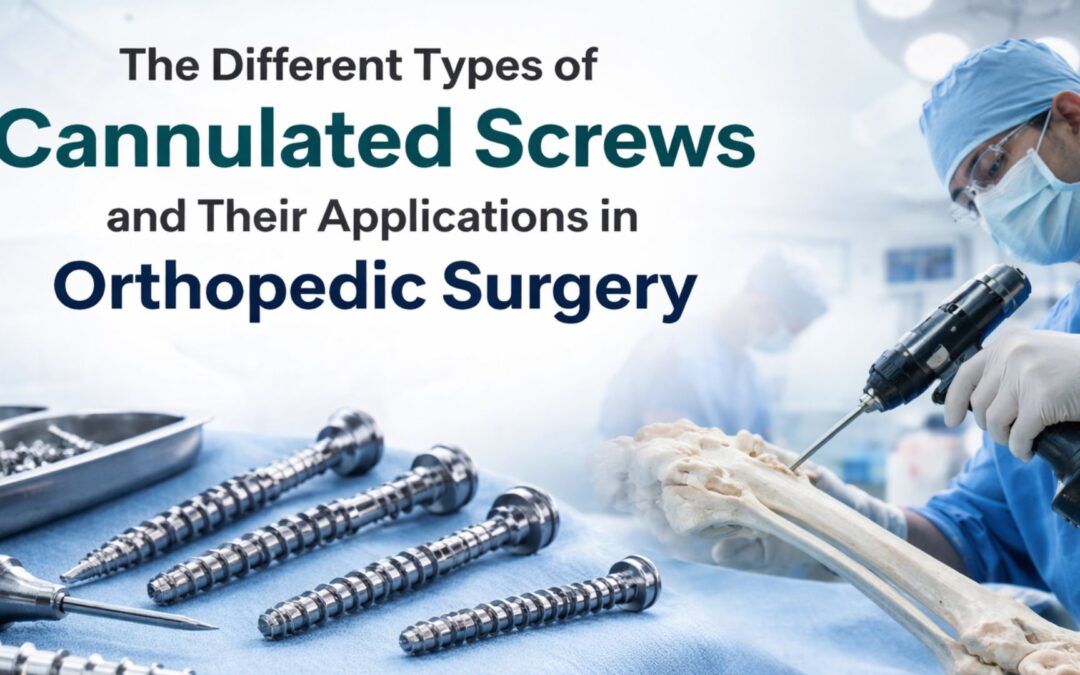
In the specialized world of orthopedic trauma and reconstruction, the Cannulated Screws system is regarded as one of the most significant mechanical advancements for achieving internal fixation. Unlike traditional solid screws, these hollow-centered instruments provide surgeons with a unique “guiding” capability that ensures unmatched accuracy during placement. By allowing the screw to be inserted over a pre-placed guide wire, medical professionals can achieve precise alignment in complex anatomical regions with minimal soft tissue disruption.
As we move through 2026, the variety of these screws has expanded to cater to specific bone densities, patient ages, and surgical sites. In this blog, we will explore the different types of Cannulated Screws and their vital applications in modern orthopedic surgery.
1. Large Diameter Cannulated Screws
Large-diameter screws are designed for high-stress areas of the body where significant load-bearing and compression are required. These are most commonly utilized in the proximal and distal regions of the long bones.
- Femoral Neck Fractures: This is perhaps the most frequent application. The hollow center is essential here, as it allows the surgeon to verify the path through the dense femoral neck using fluoroscopy before the final screw is driven home.
- Slipped Capital Femoral Epiphysis (SCFE): In pediatric orthopedics, larger cannulated systems are used to stabilize the growth plate in the hip. The precision offered by the guide wire is critical to avoid damaging the blood supply to the femoral head.
- Pelvic and Acetabular Fractures: The complex geometry of the pelvis makes “blind” screw insertion dangerous. Cannulated systems allow for safe passage through narrow bony corridors.
2. Small and Medium Diameter Screws
These screws are the workhorses of metaphyseal and joint-surface surgery. They strike a balance between providing enough compression to close a fracture gap and being small enough to avoid shattering delicate bone fragments.
- Ankle and Tibial Plateau Fractures: When a fracture extends into the knee or ankle joint, restoring the smooth joint surface is mandatory. Cannulated Screws are used to “knit” these fragments back together, often used alongside a buttress plate for added stability.
- Humerus and Elbow Injuries: Fractures of the medial epicondyle or the humeral head. The ability to place these percutaneously (through a tiny skin puncture) reduces the risk of elbow stiffness post-surgery.
3. Headless Compression Screws (HCS)
A specialized subset of Cannulated Screws, the headless design is a marvel of engineering. These screws are fully buried within the bone, meaning there is no protruding screw head to irritate the surrounding tendons or ligaments.
- Scaphoid Fractures: The scaphoid is a small, peanut-shaped bone in the wrist with a notoriously poor blood supply. Headless Cannulated Screws provide “Herbert-style” compression that stays entirely within the bone, allowing for early wrist movement without hardware interference.
- Osteochondritis Dissecans: These screws are used to fix loose cartilage and bone fragments back into place within a joint (like the knee or talus). Because they are headless, they do not damage the opposing joint surface during movement.
4. Material Variations: Titanium vs. Stainless Steel
The choice of material for Cannulated Screws depends on the patient’s long-term needs and the biomechanical environment of the fracture.
- Titanium Alloy: Preferred for permanent implants and patients with metal sensitivities. Titanium has a lower “modulus of elasticity,” meaning it behaves more like natural bone and reduces the risk of stress shielding. It is also highly compatible with MRI imaging, producing less “signal noise” than steel.
- Stainless Steel ($316L$): Often chosen for temporary fixation or in high-load trauma cases where maximum stiffness is required. While slightly heavier, stainless steel is more cost-effective and has a long, proven track record of clinical success in trauma wards globally.
Technical Advantages in 2026
The reason Cannulated Screws remain a staple in the surgical tray is their ability to facilitate Minimally Invasive Surgery (MIS). By using a “percutaneous” approach, surgeons can:
- Preserve the Hematoma: Keeping the natural healing fluids around the fracture site leads to faster bone union.
- Reduce Infection Rates: Smaller incisions mean less exposure to external pathogens.
- Shorten Recovery: Patients experience less post-operative pain and can often begin physical therapy within days rather than weeks.
Conclusion
From the micro-screws used in delicate hand surgery to the heavy-duty bolts used in hip reconstruction, Cannulated Screws are the definition of precision in orthopedics. Their evolution into headless, self-drilling, and self-tapping designs has empowered surgeons to perform complex reconstructions with greater confidence and less trauma to the patient.
As we continue to prioritize patient-specific care, the versatility of the cannulated system ensures it will remain the gold standard for internal fixation for years to come.