
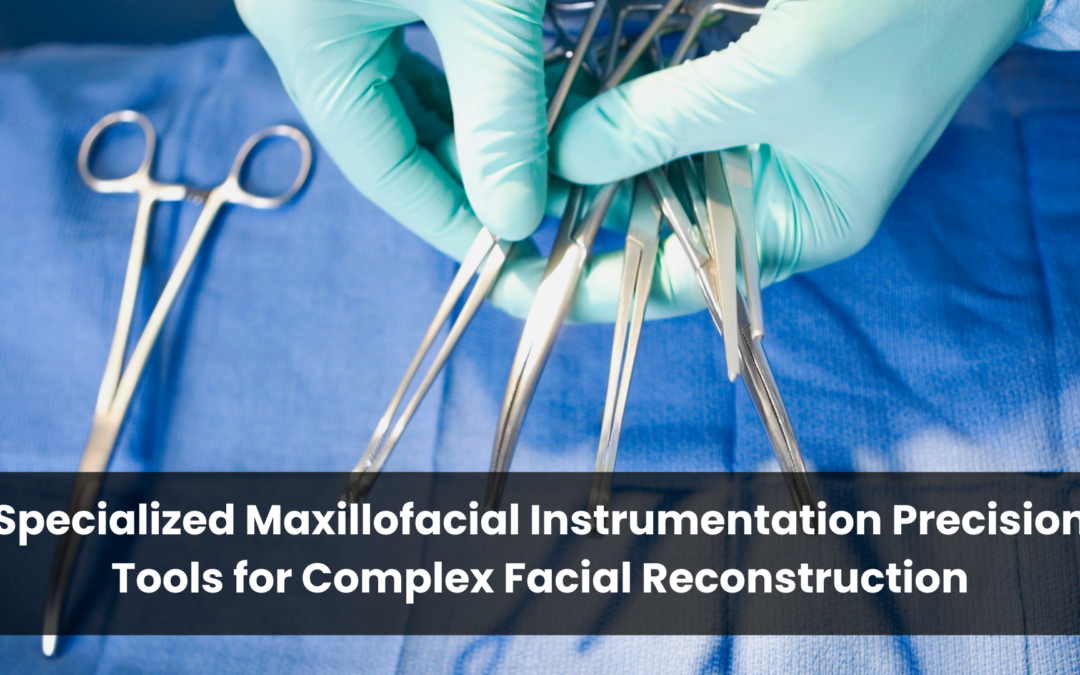
Facial anatomy is a breathtakingly complex map of delicate nerves, sensory organs, and intricate bone structures. Unlike the long bones of the body, which are built for weight-bearing, the bones of the face—the maxilla, mandible, zygoma, and orbits—are designed for expression, communication, and protection. When these structures are damaged by trauma, oncology, or congenital conditions, the surgeon requires more than just skill; they require specialized Maxillofacial Instrumentation capable of operating within millimeters of error.
The goal of maxillofacial surgery is twofold: to restore essential functions like chewing and breathing, and to preserve the patient’s aesthetic identity. Achieving this balance requires a toolkit that blends mechanical power with surgical finesse.
The Evolution of Precision in Facial Surgery
In the past, facial fractures were often treated with external wiring or bulky plates that could be felt under the skin. Today, the focus has shifted toward “Internal Fixation” using micro and mini systems. Modern Maxillofacial Instrumentation has evolved to handle these miniaturized components, allowing surgeons to work through intra-oral incisions that leave no visible scars on the face.
Precision is the cornerstone of this field. Because the facial bones are relatively thin, the instruments used to drill, cut, and plate them must be calibrated to prevent excessive heat generation or accidental penetration of the sinuses or cranial vault.
Essential Categories of Maxillofacial Instrumentation
To understand how complex reconstructions are achieved, we must look at the specialized tools that make these procedures possible:
1. Bone Cutting and Shaping Tools (Osteotomes and RASP)
Reshaping a jaw or correcting a mid-face deformity requires high-precision cutting. Specialized osteotomes are designed with ultra-thin blades to create “greenstick” fractures or clean cuts in the mandible without splintering the bone. Similarly, fine rasps allow surgeons to smooth out bony edges in the orbital rim or nasal bridge to ensure a natural contour.
2. Plate Holding and Contouring Forceps
Facial plates are incredibly small and thin. Manually bending these to fit the unique curve of a patient’s cheekbone is a delicate task. Specialized contouring forceps allow the surgeon to mold the plate in multiple planes—horizontal, vertical, and torsional—without weakening the metal or compromising the screw holes.
3. High-Torque Micro-Drills
The density of the mandible requires significant force, yet the fragility of the maxilla requires a gentle touch. Modern Maxillofacial Instrumentation includes variable-speed micro-drills that provide the tactile feedback necessary to feel the “drop” as the drill passes through the second cortex of the bone, ensuring the screw will have maximum purchase.
4. Specialized Retractors
Space is at a premium during facial surgery. Maxillofacial retractors are uniquely angled to provide a clear view of the surgical site through small openings, such as the back of the mouth or the crease of an eyelid, while protecting the facial nerve and parotid glands.
The Role of Material Science
In the realm of facial reconstruction, the materials used are just as important as the instruments. Most Maxillofacial Instrumentation is designed to work in tandem with Titanium Grade 5 implants. Titanium is the gold standard because of its high strength-to-weight ratio and its “bio-inert” properties, meaning the body is unlikely to reject it. Furthermore, because it is non-magnetic, patients can safely undergo MRI scans in the future.
Challenges in Complex Facial Reconstruction
Complex reconstruction, such as after a high-velocity impact or tumor resection, often involves “Mandibular Reconstruction.” In these cases, the surgeon may use a fibula bone graft from the patient’s leg to rebuild the jaw. This procedure is impossible without a dedicated set of Maxillofacial Instrumentation that includes cutting guides and fixation sets designed specifically for microvascular surgery.
The precision of these tools ensures that the “occlusion”—the way the upper and lower teeth meet—is perfectly restored. Even a 1-millimeter misalignment in the jaw can lead to chronic pain, difficulty eating, and long-term joint degradation (TMJ disorders).
Conclusion: Engineering the Future of Smiles
Maxillofacial surgery is where the art of aesthetics meets the rigors of medicine. The development of specialized Maxillofacial Instrumentation has turned once-impossible reconstructions into routine procedures, giving patients a second chance at a functional and confident life.
As technology advances, we are seeing the integration of 3D printing and patient-specific implants, all of which rely on high-quality manual instruments for final placement and adjustment. For the surgical team, having access to reliable, ergonomically designed tools is not just a preference—it is a requirement for excellence.
By prioritizing precision and high-grade manufacturing, the orthopedic and maxillofacial community continues to push the boundaries of what is possible in facial restoration, ensuring that every patient can speak, smile, and live without the shadow of their injury.