
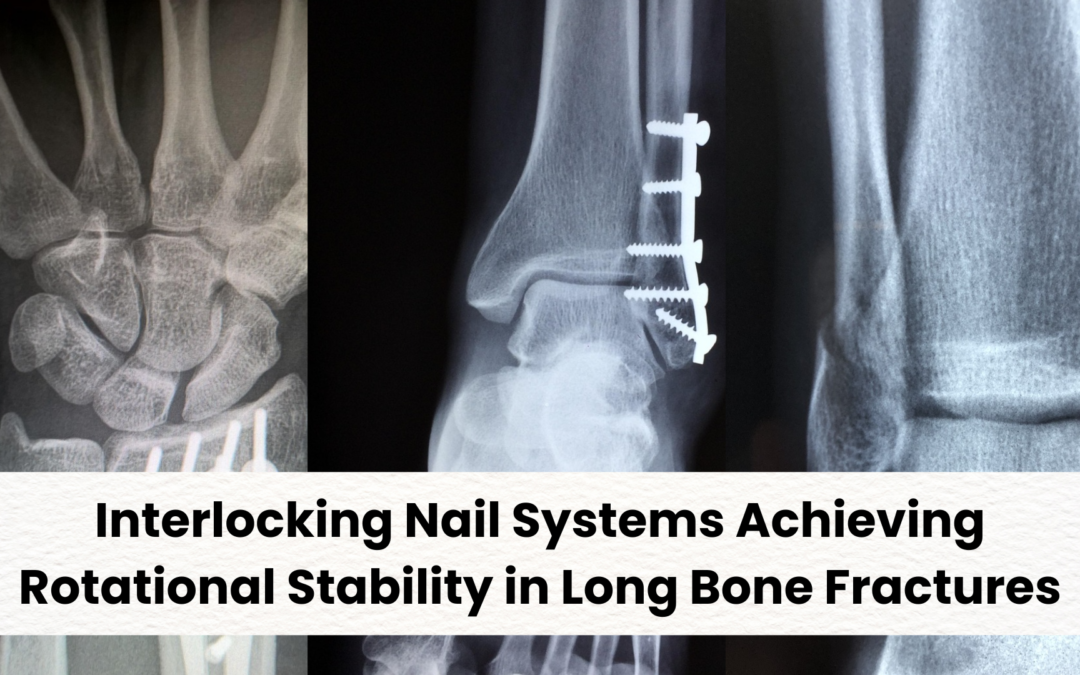
Fractures of the long bones specifically the femur, tibia, and humerus—present unique challenges to orthopedic surgeons. Unlike small bone fractures, these injuries are subject to immense mechanical stresses, including axial loading, bending forces, and, perhaps most critically, rotational (torsional) torque. Without proper stabilization, these forces can lead to malunion, nonunion, or permanent limb shortening.
In modern trauma care, the Interlocking Nail has emerged as the gold standard for managing these complex injuries. By leveraging advanced engineering and biocompatible materials, these systems provide the internal scaffolding necessary to restore patient mobility and ensure anatomical healing.
The Challenge of Rotational Instability
In the past, simple intramedullary (IM) nails relied on a “friction fit” within the bone canal. While these were effective at maintaining alignment in simple fractures, they often failed in comminuted or unstable fractures. The bone fragments would often rotate around the smooth rod, leading to a loss of alignment.
Rotational stability is the ability of an implant to prevent the bone segments from twisting independently of one another. When a fracture lacks this stability, the natural healing process the formation of a bony callus is disrupted by constant micro-motion. This instability significantly increases the risk of surgical failure and chronic pain.
How Interlocking Nail Systems Solve the Problem
The Interlocking Nail system revolutionized fracture management by introducing “locking” mechanisms. These are transverse screws or bolts passed through pre-drilled holes at the proximal (top) and distal (bottom) ends of the nail.
- Fixed Framework: By anchoring the nail to the hard outer cortex of the bone at both ends, the implant creates a rigid “nail-bone construct.”
- Mechanical Locking: The transverse screws act as physical barriers that prevent the bone from sliding up or down the nail (axial stability) and, more importantly, from twisting around it (rotational stability).
- Load Sharing: Unlike bone plates, which bear the entire weight, an Interlocking Nail is a load-sharing device. It sits in the center of the bone, allowing for controlled physiological stress that actually stimulates faster bone growth and remodeling.
Key Benefits for Patient Recovery
The shift toward advanced intramedullary fixation has provided several clinical advantages that directly impact patient outcomes:
| Feature | Clinical Benefit |
| Minimally Invasive | Preservation of blood supply and reduced infection risk. |
| Mechanical Rigidity | Immediate stabilization allows for earlier mobilization. |
| Controlled Dynamization | Ability to switch from static to dynamic locking to promote healing. |
| Anatomical Alignment | Prevents limb shortening and rotational deformities. |
1. Minimally Invasive Entry
These nails are typically inserted through small incisions using “closed” techniques. This preserves the periosteal blood supply around the bone and minimizes soft tissue damage, which is vital for reducing post-operative complications.
2. Early Weight-Bearing
Because the nail provides immediate mechanical stability, many patients can begin protected weight-bearing exercises much sooner than with traditional casting or plating. This early movement prevents muscle atrophy and joint stiffness.
3. Reduced Risk of Malunion
By ensuring precise rotational and axial alignment, the risk of “malunion” (where the bone heals at an incorrect angle) is significantly minimized. This is particularly important in the femur and tibia, where even a few degrees of rotational error can affect a patient’s gait and long-term joint health.
Material Science and Design
Quality is paramount when an implant is destined to become a permanent part of a patient’s anatomy. Modern Interlocking Nail systems are crafted from medical-grade Titanium or Stainless Steel 316L, ensuring maximum biocompatibility and corrosion resistance.
Titanium alloys are often preferred for their “elastic modulus,” which is closer to that of human bone compared to stainless steel. This reduces the risk of “stress shielding,” where the bone becomes weak because the metal is doing too much of the work.
Conclusion: Restoring Movement with Confidence
The transition from traditional IM nails to advanced Interlocking Nail systems has transformed orthopedic outcomes worldwide. By successfully achieving rotational stability, these implants provide the foundation for a faster, safer, and more predictable recovery.
For healthcare providers, utilizing high-precision trauma implants is essential to tackle the most demanding long bone fractures. Through these engineering solutions, the medical community continues to empower patients to stand, walk, and move with confidence once again.