
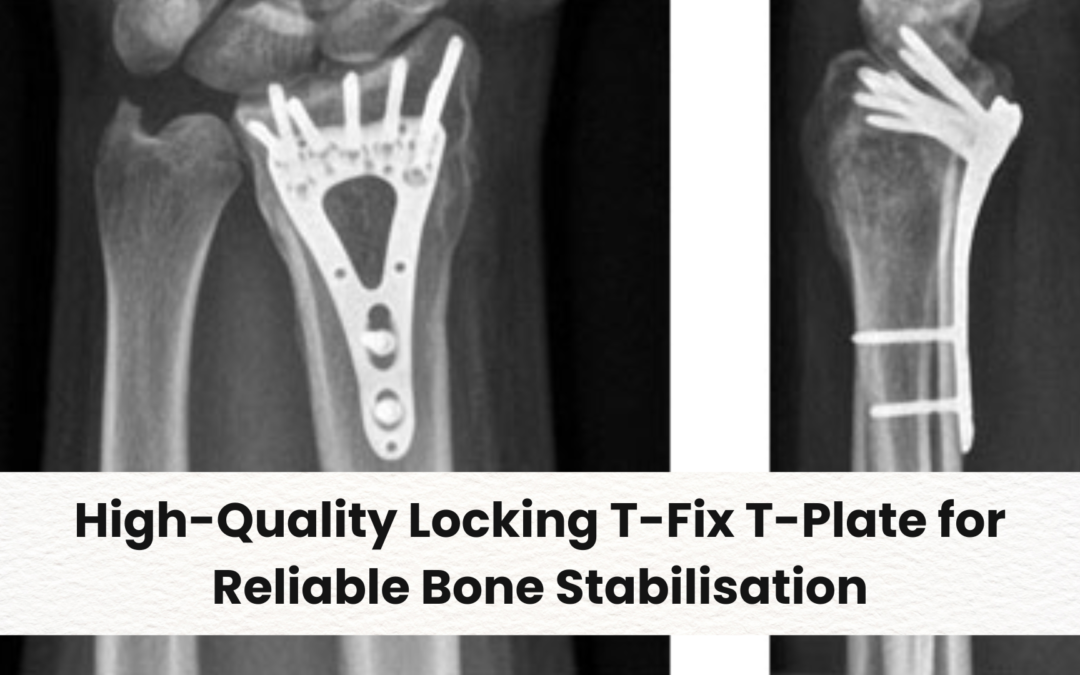
Orthopedic surgery is a field where the margin for error is nearly non-existent. When a patient suffers a complex fracture, the primary goal of the surgeon is to restore anatomy and ensure the patient can return to their daily life as quickly as possible. Among the various tools available to modern surgeons, the Locking T-Fix T-Plate has emerged as a gold standard for treating fractures in specific anatomical regions, particularly where bone density is a concern or where the fracture pattern is highly unstable.
Understanding the Mechanics of the Locking T-Fix T-Plate
The “T” in the T-Plate isn’t just for aesthetics; it is a functional design choice. These plates are specifically engineered for the metaphyseal and diaphyseal regions of long bones—most commonly the distal radius (wrist) or the proximal humerus (shoulder).
Traditional plates rely on the friction between the plate and the bone to achieve stability. However, the Locking T-Fix T-Plate operates on a different principle. By utilizing locking screw technology, the screws thread into the plate itself, creating a “fixed-angle construct.” This means the plate and screws act as a single internal splint. This is a game-changer for patients with osteoporotic bone, where traditional screws might struggle to find a solid grip.
Why Precision Engineering Matters
In the world of orthopedic manufacturing, precision is the difference between a successful recovery and a painful revision surgery. A high-quality Locking T-Fix T-Plate must possess three critical characteristics:
- Anatomical Contouring: Human bones aren’t flat. A high-quality plate is pre-contoured to match the natural curvature of the bone. This reduces the need for the surgeon to bend the plate manually during surgery, which can weaken the metal and increase operating time.
- Low Profile Design: One of the most common complaints after fracture fixation is “hardware prominence”—where the patient can feel the plate under their skin. Modern T-Plates are designed with a low profile and rounded edges to minimise soft tissue irritation and tendon friction.
- Material Integrity: Whether crafted from medical-grade Titanium or Stainless Steel, the material must offer the perfect balance of rigidity and flexibility. It needs to be strong enough to bear the load of the limb but flexible enough to prevent “stress shielding,” a phenomenon where the bone weakens because the metal plate is doing too much of the work.
The Clinical Advantage: Why Surgeons Choose T-Fix
Surgeons often prefer the Locking T-Fix T-Plate for complex intra-articular fractures (fractures that extend into the joint). Because these plates allow for multiple locking screws to be placed in the “head” of the T-shape, they provide superior subchondral support. This prevents the joint surface from collapsing during the healing process.
Furthermore, the “Fixed-Angle” stability offered by these plates allows for early mobilisation. In the past, a patient might have been cast for weeks, leading to joint stiffness. With the reliable stabilization of a locking T-Plate, many patients can begin gentle range-of-motion exercises much sooner, which significantly improves the long-term functional outcome.
India’s Contribution to Bone Stabilization Technology
As we have discussed in the context of the global supply chain, Indian manufacturing has reached a point where it is setting global benchmarks for orthopedic implants. By utilising advanced CNC machining and rigorous quality control protocols, manufacturers in India are producing Locking T-Fix T-Plate systems that are utilized in trauma centers worldwide.
These products undergo rigorous testing, including fatigue testing and biocompatibility assessments, ensuring that they meet the stringent requirements of international healthcare bodies. For the patient, this means access to world-class technology that is both reliable and durable.
The Path to Recovery
Choosing the right implant is only half the battle; the surgical technique and post-operative care complete the journey. However, having a reliable, high-precision instrument like the Locking T-Fix T-Plate gives both the surgeon and the patient a head start. It provides the “mechanical peace” that bone tissue needs to knit back together.
Conclusion
Fracture management has come a long way from the days of simple casts and non-locking plates. The introduction of the Locking T-Fix T-Plate represents a significant leap forward in high-precision orthopedic engineering. By providing rigid, fixed-angle stabilisation, these plates offer a lifeline for patients with complex fractures or compromised bone quality.
At the intersection of engineering and medicine, these plates serve a single, vital purpose: to bring stability back to a life interrupted by injury. As manufacturing continues to evolve, we can expect even more refined designs that further reduce recovery times and improve the quality of life for patients globally.