
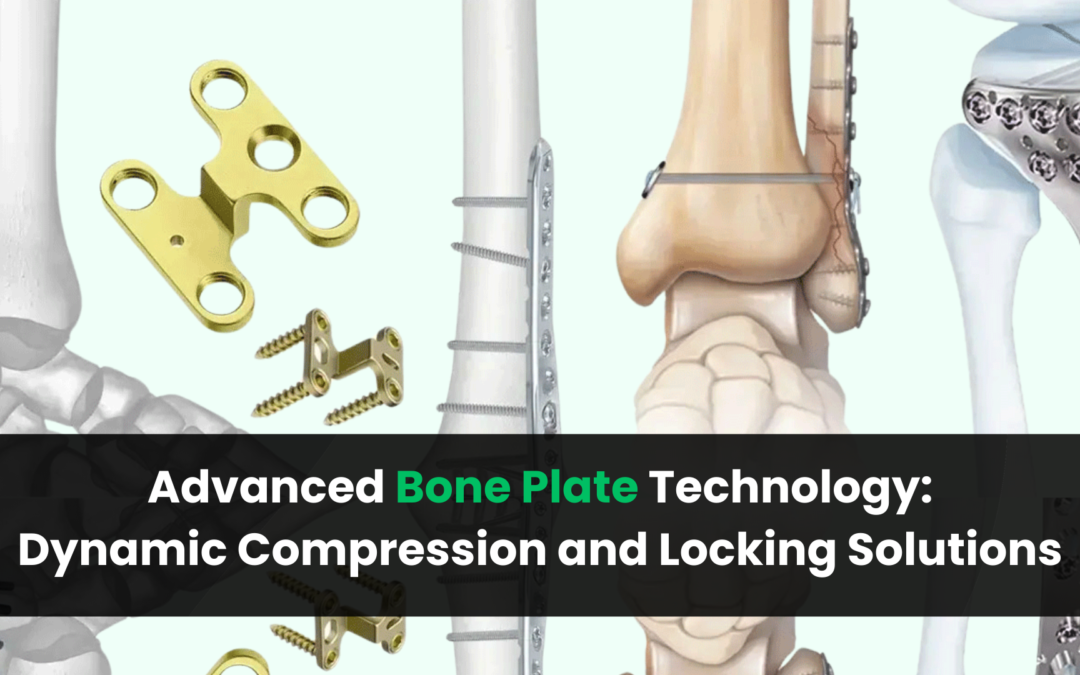
The field of orthopedic traumatology has witnessed a tectonic shift in how fractures are managed. From the rudimentary splints of the past to the sophisticated internal fixation devices of today, the primary goal remains the same: restoring anatomical alignment and ensuring early mobility. At the heart of this evolution is the Bone Plate, a versatile implant that has transitioned from a simple “connector” to a highly engineered biological tool.
In modern surgery, the debate often centers on two primary technologies: Dynamic Compression Plates (DCP) and Locking Compression Plates (LCP). Understanding the nuances of these solutions is essential for achieving optimal patient outcomes and minimizing post-operative complications.
The Foundation: Dynamic Compression Technology
The introduction of the Dynamic Compression Plate (DCP) revolutionized fracture care by introducing the concept of “absolute stability.” These plates utilize an oval-shaped hole design. When a screw is inserted eccentrically—away from the center of the hole—it slides the bone fragment toward the fracture line as the screw head tightens.
Why it matters:
- Primary Bone Healing: By pressing the two ends of a broken bone together (compression), the DCP eliminates the gap where a callus would normally form. This leads to “primary healing,” where the bone remodels directly across the fracture site.
- Friction-Based Stability: The stability of a standard Bone Plate relies on the friction between the plate and the bone surface. This requires the plate to be pressed firmly against the bone, which is highly effective for simple, transverse fractures in healthy bone tissue.
The Evolution: Locking Solutions for Complex Fractures
While dynamic compression is the gold standard for many, it faces limitations in poor-quality bone or complex, multi-fragmentary (comminuted) fractures. This is where Locking Bone Plate technology steps in.
In a locking system, the screw head threads directly into the plate itself, creating a “fixed-angle construct.” Unlike traditional plates, the stability does not depend on the plate-to-bone friction. Instead, the plate acts as an “internal fixator.”
Key Advantages of Locking Systems:
- Preservation of Blood Supply: Because the plate doesn’t need to be squeezed against the bone, the periosteal blood vessels—which are crucial for healing—remain largely undisturbed.
- Superior Performance in Osteoporosis: In older patients with “soft” bones, traditional screws can often strip the bone or pull out. Locking screws, however, provide a mechanical “monoblock” effect that significantly increases resistance to failure.
- Fixed-Angle Stability: This is vital for fractures near joints (periarticular fractures), where maintaining the specific angle of the bone is necessary for long-term joint function.
Hybrid Innovations: The Best of Both Worlds
The most recent advancement in Bone Plate technology is the development of “Combi-holes.” These are specialized plate designs that feature a figure-eight shaped hole. One side of the hole is designed for dynamic compression, while the other side is threaded for locking screws.
This hybrid approach allows surgeons to customize the fixation for every individual patient. They can compress the main fracture line to promote primary healing and then use locking screws at the ends of the plate to ensure maximum stability in the surrounding bone.
Why Material and Design Precision Matter
The effectiveness of any Bone Plate is only as good as its engineering. Modern implants are typically crafted from medical-grade Titanium alloys or Stainless Steel 316L.
- Titanium: Favored for its superior biocompatibility and “elastic modulus,” which is closer to human bone, reducing the risk of “stress shielding” (where the bone becomes weak because the plate is too stiff).
- Low-Profile Design: Modern plates are designed with tapered ends and smooth surfaces to minimize irritation to the surrounding muscles and skin—a crucial factor in areas with little soft tissue, like the wrist or ankle.
Conclusion: Elevating Patient Care
The choice between dynamic compression and locking solutions is not about which is “better,” but which is more appropriate for the specific injury. Dynamic compression remains unrivaled for simple fractures in healthy bone, while locking technology has opened doors for treating complex trauma and geriatric patients who previously had limited options.
At the intersection of these technologies lies a future where fracture recovery is faster, safer, and more predictable. By leveraging high-quality, precision-engineered Bone Plate systems, surgeons can provide patients with the stability they need to return to their daily lives with confidence.