

In orthopedic surgery, achieving and maintaining proper bone alignment after a fracture or during reconstructive procedures is a cornerstone of successful patient outcomes. Among the various methods available, skeletal traction remains a vital technique, particularly in managing femoral or tibial fractures before definitive internal fixation.
The effectiveness of skeletal traction relies heavily on the hardware used to transmit force directly to the bone. Two of the most commonly utilized tools for this purpose are the Steinmann pin and the Denham Pin. While they may appear similar to the untrained eye, their design differences lead to distinct clinical applications. Understanding these nuances is essential for surgical teams aiming to minimize complications like pin-tract infections or loosening.
Understanding the Steinmann Pin
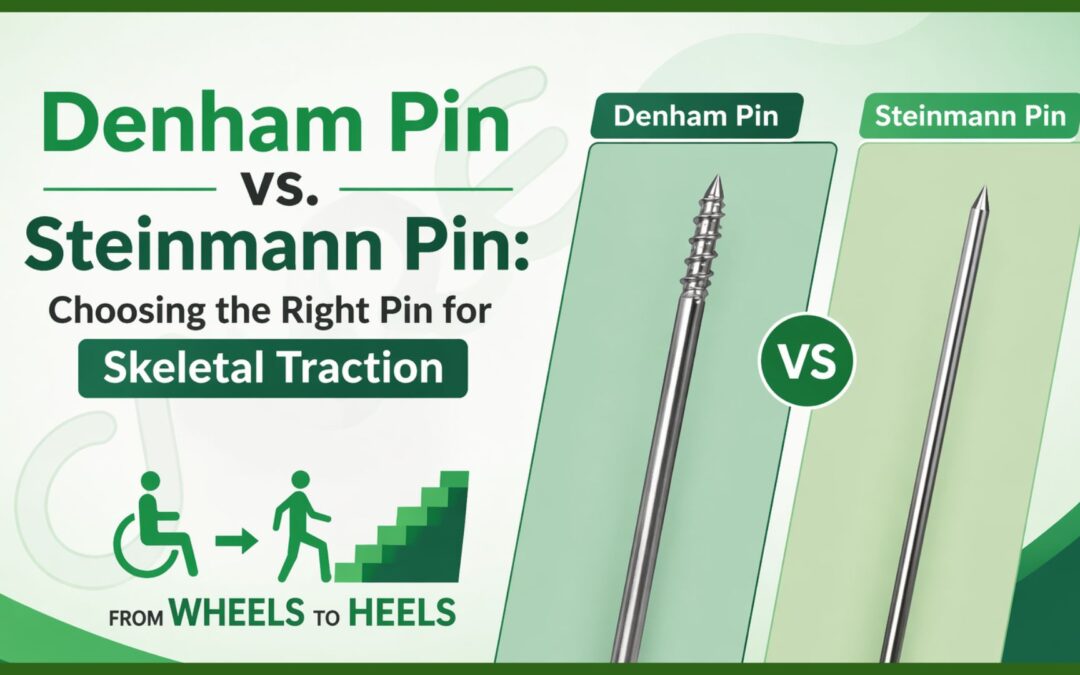
The Steinmann pin is perhaps the most well-known stainless steel or titanium rod used in orthopedics. It features a smooth cylindrical body and is available in various diameters, typically ranging from 2.0mm to 5.0mm. The tips are usually trocar or diamond-shaped to allow for easier penetration of the cortical bone.
Because the shaft of a Steinmann pin is entirely smooth, it relies solely on the friction between the metal and the bone to stay in place. While this makes insertion and eventual removal straightforward, it also introduces a specific risk: migration. In high-tension skeletal traction, a smooth pin can slide laterally, potentially irritating surrounding soft tissue or compromising the stability of the traction setup.
The Specialized Design of the Denham Pin
The Denham Pin was designed specifically to address the limitations of the smooth Steinmann pin. At first glance, it resembles its counterpart, but it features a critical modification: a threaded central section.
This threaded portion is designed to engage with the cancellous bone or the cortex. By “locking” into the bone, the Denham Pin provides significantly higher resistance to lateral movement. This mechanical advantage is particularly beneficial when traction needs to be maintained for an extended period or when the patient is expected to move during recovery.
Key Differences and Clinical Selection
Choosing between these two pins is not a matter of one being “better” than the other, but rather which is more appropriate for the specific clinical scenario.
1. Stability and Fixation
The primary advantage of the Denham Pin is its stability. In cases where the bone quality is osteoporotic or where the traction weight is substantial, the threads prevent the pin from “sawing” through the bone or sliding. If a procedure requires long-term traction (weeks rather than days), the threaded design is often preferred to maintain the integrity of the setup.
2. Risk of Infection
Pin-tract infection is a common complication in skeletal traction. Research suggests that pin loosening is a precursor to infection; as the pin moves, it creates a gap that allows bacteria to migrate from the skin surface down to the bone. Because the Denham Pin stays securely fixed, it can theoretically reduce the incidence of pin-tract sepsis by preventing the “pistoning” effect often seen with smooth pins.
3. Ease of Removal
The Steinmann pin wins in terms of simplicity of removal. Since it lacks threads, it can be pulled through the bone with minimal trauma once the traction period is over. Removing a Denham Pin requires unscrewing the threads from the bone. While this is a standard procedure, it can be slightly more involved if the bone has integrated closely with the threads over a long period.
Application Scenarios
In modern orthopedic practice, the choice often follows these general guidelines:
- Steinmann Pins are frequently chosen for short-term applications, such as intraoperative reduction where the pin will be removed within hours, or for pediatric patients where the bone is softer and the traction weights are lower.
- Denham Pins are the gold standard for calcaneal or proximal tibial traction in adults, especially when definitive surgery might be delayed. The robust fixation ensures that the mechanical pull remains consistent without the risk of the hardware shifting and causing secondary soft tissue damage.
Critical Considerations for Insertion
Regardless of the pin selected, the technique remains paramount. Surgeons must ensure that the pin is inserted perpendicular to the longitudinal axis of the bone to ensure even distribution of the traction force. Utilizing a sharp, high-quality pin is essential to reduce thermal necrosis—a condition where the heat generated during high-speed drilling kills the surrounding bone cells, leading to early loosening.
Using a hand drill or a low-speed power drill is often recommended to maintain the biological integrity of the bone surrounding the Denham Pin threads. Furthermore, ensuring the skin is under no tension at the entry and exit points is a simple but effective way to prevent early-stage inflammation.
Conclusion
The decision to use a Denham Pin versus a Steinmann pin depends on the duration of the traction, the quality of the patient’s bone, and the specific site of injury. For clinicians, the threaded security of the Denham design offers a reliable solution for long-term stability and reduced risk of migration-related complications. By matching the hardware to the patient’s specific needs, orthopedic teams can ensure a smoother transition from initial stabilization to final recovery.
