

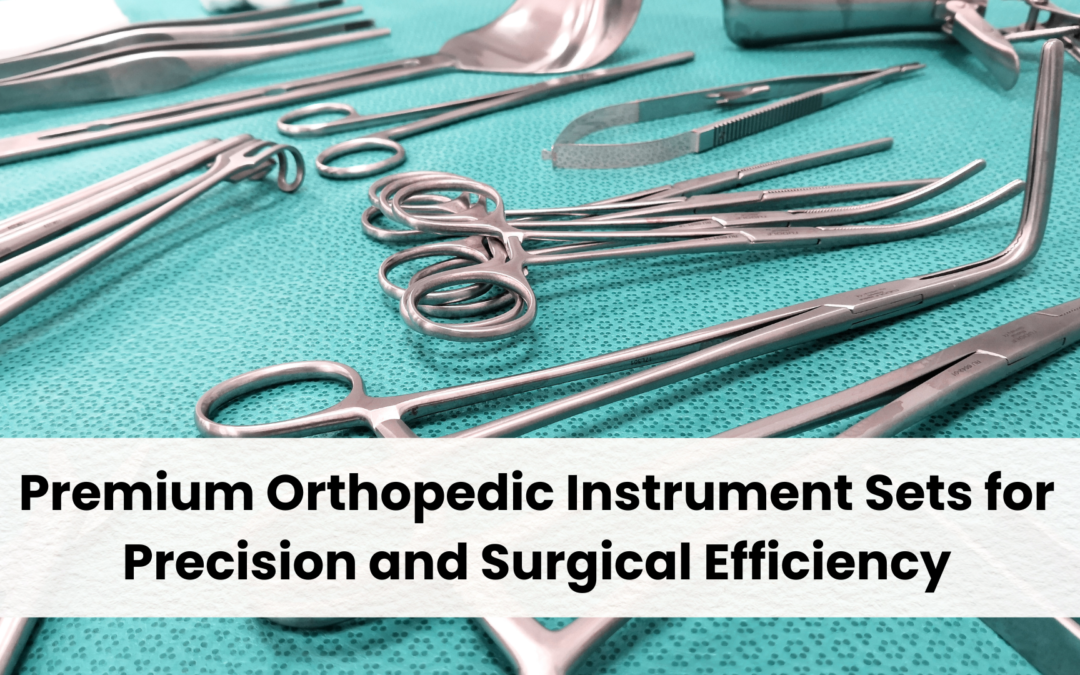
In the rapidly evolving field of orthopedic surgery, the demand for high‐quality, reliable instrumentation has never been greater. The margin for error is small, the expectations are high, and the outcomes matter deeply for both surgeon and patient. This is why choosing the right Instrument Set becomes a critical decision. At Ortho Care (based in New Delhi, India) and its wide distribution globally, the focus on manufacturing premium orthopedic instruments underlines the importance of performance, durability and precision.
In this blog we’ll explore the key considerations when selecting an orthopedic instrument set, the benefits of premium sets, how they contribute to surgical efficiency and precision, and why Ortho Care’s offerings merit careful evaluation.
Understanding the Instrument Set in Orthopedic Surgery
Before diving into what makes a premium set, it helps to clarify what we mean by Instrument Set in this context. In orthopedic surgery, an instrument set is a curated collection of surgical tools that are designed for a particular procedure or family of procedures — for example, plating, nailing, screw fixation, trauma repair, arthroscopy, spinal instrumentation, etc.
Such sets typically include drills, saws, taps, reamers, screwdrivers, plate benders, forceps, holders, reduction tools, depth gauges, and more. The instrumentation is designed to function seamlessly with implants (plates, screws, nails), enable accurate alignment, minimize soft‐tissue damage, reduce operating time, and enhance reproducibility of outcomes.
When a surgeon opens a well‐organized instrument set, the workflow can proceed smoothly. The right instrument is where it should be, the tolerances are predictable, the mechanics feel precise, and the staff supporting the case can anticipate the next step. Conversely, when instrumentation is sub‐par, the risks include delays, intraoperative frustration, increased soft‐tissue trauma, and even compromised outcomes.
In short: the instrument set is the backbone of surgical execution.
Why Premium Instrument Sets Matter
It might be tempting to view instruments as more or less “commodity” – after all, a drill is a drill, a screwdriver is a screwdriver. But in orthopedic surgery this thinking doesn’t hold up. Here are key reasons why investing in a premium instrument set makes sense.
1. Precision and Tolerance
Premium sets are manufactured to tighter tolerances, with better surface finishes, consistent mechanical behavior, and more robust materials. This means when the surgeon engages a screw, or when one uses a reduction clamp, the behaviour is predictable and reliable. Small variances add up: less play in a drill chuck, smoother articulation in a clamp, better ergonomics in a screwdriver—all add to surgical precision.
2. Reliability and Durability
Orthopedic surgery is unforgiving: instruments are exposed to repeated sterilization cycles, rigorous use, often in emergency settings, and must hold up. Premium sets use higher‐grade stainless steels or other alloys, precise manufacturing and often enhanced surface treatments to resist corrosion, wear, and mechanical fatigue. A premium instrument set stays “in spec” longer, reducing replacement downtime and cost.
3. Integrated Workflow
When the instrument set is well‐designed, it integrates seamlessly with implants, reducing intraoperative improvisation. For example, a set designed for plating will include plate benders, reduction handles, screwdrivers, depth gauges, etc., all in one system—this speeds up case flow and helps avoid delays. When a surgeon is using instruments that “fit” the implants and each other, everything flows.
4. Efficiency and Surgeon Ergonomics
Operating time is a precious resource. Premium instruments reduce the friction in surgery: fewer interruptions, less time searching for tools, smoother transitions between steps. A well‐designed set has intuitive layout, clear instrument identifiers, ease of sterilization and re‐sterilization, and ergonomics that reduce fatigue for the surgeon and staff. All of these contribute to surgical efficiency. That matters for both patient safety and hospital economics.
5. Patient Outcomes
At the end of the day, better instrumentation helps the surgeon deliver better outcomes. Reduced operative time, less soft‐tissue trauma, better alignment of implants, fewer intraoperative surprises—all contribute to faster recovery, fewer complications, and improved overall patient experience.
Key Features to Look for in an Orthopedic Instrument Set
When selecting an instrument set for orthopedic surgery (trauma, joint reconstruction, spinal instrumentation, etc), here are the features to scrutinize:
a) Comprehensive Kit
A premium instrument set should include all tools required for the particular surgical modality. For example, a plating set should have reduction tools, plate benders/contours, screwdrivers in multiple sizes, depth gauges, tap and drill bits, insertion/extraction tools. Coverage helps avoid last‐minute borrowing or mixing instruments from different sets (which can introduce inconsistency).
b) Compatibility with Implants
The instruments should be designed specifically to work with the corresponding implants (plates, screws, nails). Mis‐matched instruments can lead to problems like screw‐strip, imprecise fit, or worse. A truly premium set ensures full compatibility and often features unique instrument designs for that implant architecture.
c) Ergonomic and Intuitive Layout
How the instruments are organized in the tray/matrix matters. Instruments should be arranged logically, labelled clearly, and stored in a way that helps sterilisation, transport, and intraoperative access. Ease of picking, returning, and sterilising reduces time waste.
d) Material Quality & Surface Treatment
Look for high‐grade stainless or specialty steel, corrosion and wear‐resistant coatings, precision machining. These ensure durability and consistent behaviour over many cycles. Premium sets often advertise compliance with standards like ISO 13485, CE certification, etc.
e) Tray/Case Design
The instrument case or tray should be robust, easy to sterilize, compact yet accessible. Instruments should be securely held in position to avoid damage during transport or sterilisation cycles. Premium sets often offer protective inserts or foam cut‐outs that hold each instrument firmly.
f) Servicing & Maintenance Support
Instrument sets are a long‐term investment. A good vendor will offer servicing, replacement parts, refurbishment, documentation, and support. Part of a premium offering is the vendor’s commitment to the lifecycle of the instrumentation.
g) Global Standards and Certifications
Standards like CE marking, ISO 13485, US FDA clearance for devices (where applicable) signal that the manufacturer meets rigorous quality systems. For example, Ortho Care notes its ISO 13485:2016 certification and US-FDA 510(k) cleared products.
The Role of the Instrument Set in Different Orthopedic Modalities
Let’s examine how instrument sets function in various key orthopedic domains:
Trauma & Fracture Fixation
In trauma surgery, time is critical, anatomical restoration is essential, and implants must be placed accurately under variable conditions. The instrument set for fracture fixation might include reduction clamps, plate benders, screwdrivers specifically for locking screws, depth gauges, trial plates, angled drills, etc. Surgeons rely on instruments that allow rapid adaptation—changing plate length, adjusting for bone quality, etc.
For example, a “Plating Instrument Set” or “Nailing Instrument Set” would be designed for modular adaptation—not just one plate size, but a range; not just straight screws, but locking screws and variable angle options. This demands a robust instrument set that is ready for the unpredictable.
Joint Reconstruction & Arthroplasty
Even in joint reconstruction (hip, knee, shoulder), while the instrumentation may lean toward the implant system rather than pure trauma tools, the principle remains: alignment, precision, and reproducibility. The instrument set may include jigs, trial components, specialized screwdrivers, reamers, rasps, trial implants and final implants. The tray distribution, instrument organisation, and case flow are all influenced by how well the instrument set supports the procedure.
Spinal Surgery
Spine instrumentation is among the most demanding: long implants, multiple segments, precision alignment, neurological risk, and the need for high reliability. Instrument sets for pedicle screws, cages, rods, osteotomy tools must be robust, ergonomically organised, and easy to handle under long operative times. Here again, a premium instrument set becomes essential.
Minimally Invasive and Arthroscopy
In minimally invasive procedures, instrumentation is challenged by limited access, narrow portals, and highly precise movements. Instrument sets must be compact, well-organised, and made of materials that allow smooth manipulation in tight spaces. The premium set ensures the instruments behave exactly when the surgeon needs them to.
How Ortho Care’s Instrument Sets Fit the Bill
As a manufacturer and supplier with global distribution (over 60 countries) and multiple certifications, Ortho Care is well positioned to deliver premium instrument sets. Here’s how their offerings align with the features we’ve discussed:
- Certification and Quality Systems: The company states compliance with ISO 13485:2016, CE certification and US-FDA 510(k) clearance for its products. This signals rigorous design control, manufacturing oversight and regulatory compliance.
- Broad Product Range: Their product list includes “Instrument Sets” with variations like “Instrument For Plating”, “Instrument For Nailing”, “Instrument For Screws”, “Hand Instrument Set”, “ACL/PCL Instrument Set” etc. This breadth means surgeons and hospitals can source integrated sets for a wide range of procedures.
- Global Reach and Experience: With a presence in over 60 countries, they’ve earned trust in diverse markets, which indicates robustness in logistics, servicing and global standards.
- Competitive Pricing with Quality Focus: Ortho Care emphasizes delivering high-quality products at competitive pricing by focused R&D and streamlined manufacturing.
- Instrument & Implant Integration: Their website emphasizes both implants and instrumentation — meaning the instrument sets are designed in harmony with their implant systems, which is crucial for optimal surgical workflows.
For hospitals, surgical centres and procurement departments in India and abroad, this combination of premium quality, integrated design, cost-effectiveness and servicing support makes the instrument set offerings worth serious consideration.
Benefits of Upgrading to a Premium Instrument Set
Let’s summarise the key benefits for a hospital or surgical team when moving to a premium instrument set:
- Reduced Operating Time
With organised trays, intuitive layouts, engineered instruments, and minimised intraoperative improvisation, surgical time can be reduced. Time savings translate into less anesthesia exposure, lower infection risk, and better throughput for busy operating theatres. - Improved Surgical Precision
Premium instruments reduce variability. That means better implant placement, fewer technical errors, and more predictable outcomes. For fracture fixation this means better alignment; for arthroplasty it means better component placement; for spine it means improved instrumentation stability. - Lower Long-term Instrument Costs
While the upfront investment may be higher, premium instrument sets are more durable and often require less frequent replacement or refurbishment. Fewer instrument failures, fewer lost items, fewer maintenance issues. - Better Surgeon Experience & Staff Efficiency
Surgeons working with high-quality instrumentation report less frustration, smoother workflows, faster case turnarounds, and less staff training overhead. Instrument staff appreciate sets that are logically organised and designed for reuse/sterilisation. - Enhanced Patient Experience & Outcomes
Faster surgery, fewer complications, less soft-tissue trauma, improved outcomes all feed back into hospital reputation, patient satisfaction, lower readmission rates and better cost-effectiveness. - Scalability & Versatility
A modular premium instrument set allows adaptation across multiple case types—trauma, elective, revision, minimally invasive, etc. This flexibility is valuable in mixed surgical suites.
Considerations Before Purchase or Upgrade
If you’re part of a surgical team, procurement department or hospital leadership looking to acquire or upgrade an instrument set, keep the following considerations in mind:
• Case Mix and Frequency
What kinds of orthopedic cases does your centre perform (trauma only, elective arthroplasty, spine, paediatric, etc)? The instrument set should match your volume and case types. If your hospital does many trauma cases, a full “Instrument for Nailing / Plating” set is indispensable.
• Compatibility with Existing Implants
If you already use a specific implant system, ensure the new instrument set is fully compatible or plan for converting to a new implant offering entirely. Mismatches can cause surgical inefficiencies or worse.
• Training and Staff Familiarisation
New instrument sets often require a learning curve for surgical staff and OT instrument nurses. Choose a supplier who supports training, provides manuals, quick reference guides and perhaps in-case training.
• Maintenance, Sterilisation and Logistics
Evaluate how well the instrument case/tray withstands sterilisation cycles, how easily the instruments can be cleaned and maintained, how replacement parts are managed. Premium sets often come with service contracts or instrument lifecycle plans.
• Supplier Support & After-Sales Service
A good manufacturer will provide replacement parts, refurbishment services, technical support, and strong logistics. When an instrument breaks or goes missing, downtime must be minimised.
• Cost versus Value
Don’t just look at price. Consider total cost of ownership: instrument longevity, reduced repair/replacement, improved OR efficiency, improved outcomes. A premium instrument set may cost more upfront but save more over time.
• Documentation and Traceability
In today’s healthcare environment, traceability of instruments, sterilisation logs, maintenance logs, compliance with regulatory standards are important. The instrument set provider should support documentation and quality assurance.
Case Study: Using an Instrument Set in Trauma Surgery
Let’s walk through a hypothetical scenario to illustrate how a premium instrument set makes a difference.
Scenario: A busy tertiary hospital is handling open fracture cases (e.g., tibial shaft fractures with associated soft tissue injury). The surgical team uses an “Instrument Set for Nailing” designed for the specific intramedullary nail system.
Without Premium Set:
- The instrument tray has mixed tools from different suppliers; certain missing items cause delays.
- The reduction clamps have small play, leading to minor malalignment which needs intraoperative correction.
- The screwdriver for locking screws slips occasionally, adding to implant insertion time.
- The tray layout is confusing, instrument retrieval takes longer, and sterilisation cycles lead to occasional rust spots on older tools.
With Premium Instrument Set:
- The tray is organised, colour-coded; each instrument has a labelled slot. Staff knows exactly where to pick.
- Reduction clamp has precision hinge, minimal play, enabling accurate alignment on first attempt.
- Screwdriver offers firm engagement with locking screws; insertion is smooth with no slip-backs.
- Instruments are made of high-grade steel, surface treated; tray withstands sterilisation cycles reliably.
- Surgical time is reduced, intraoperative adjustments are fewer, surgeon and staff workflow is smoother.
- Postoperative alignment is excellent; patient recovers faster and with fewer complications.
This scenario highlights how investing in a high-quality instrument set is not just a nice‐to‐have, but a practical contributor to surgical success, patient outcomes and operational efficiency.
Why the Indian Market Should Pay Attention
India is a rapidly growing market in orthopedic surgery — both in trauma (given the high incidence of fractures) and in elective joint replacement (with rising life expectancy and expanding middle class). Domestic manufacturers like Ortho Care are meeting global standards while supplying affordable instrumentation and implants. This offers several advantages:
- Local Support & Service: Locally based manufacturers can often offer faster service, quicker delivery of parts, and easier training logistics.
- Cost Competitiveness: Domestic manufacturing often means lower cost compared to imported sets, without compromising on quality when certified.
- Adapted to Indian Context: The instrument sets may be tailored to Indian OR workflows, surgical case mix (e.g., high trauma volumes), and sterilisation infrastructure.
- Global Standards: As in the case of Ortho Care, domestic manufacturers can meet ISO/CE/US FDA standards and export to 60+ countries.
- Scalability for Smaller Hospitals: Tier-II and Tier-III hospitals may benefit from modular premium instrument sets rather than fragmented single‐instruments.
For Indian hospitals, upgrading instrumentation via a premium instrument set from a trusted domestic manufacturer is a pragmatic step to enhance surgical capabilities without necessarily incurring exorbitant cost.
Best Practices for Implementing a New Instrument Set
Once you decide to acquire a premium instrument set, here are some best practices to ensure the transition is smooth and maximises value:
✔ Inventory Audit and Mapping
Before implementation, audit existing instruments: what works, what doesn’t, what is missing, what duplicates you have. Map the new instrument set to existing workflows and identify gaps or redundancies.
✔ Staff Training & Simulation
Run a training session with the surgical team, nurses and instrument technicians. Familiarise everyone with the layout, sterilisation protocol, instrument identification, and intraoperative sequence.
✔ Sterilisation and Care Protocols
Premium sets are durable but still need care. Ensure instruments are handled correctly after use, cleaned per manufacturer instructions, inspected regularly, and logs maintained. This protects the investment and ensures consistent performance.
✔ Tracking Usage & Maintenance
Keep track of case usage, instrument performance, any breakdowns, missing tools, repairs. This data helps evaluate ROI, plan for servicing and replacement, and inform future decisions.
✔ Feedback Loop with Surgeons
Encourage surgeons to provide feedback after cases: how did the instrumentation perform, any snags, any missing items, suggestions for improvement. A good instrument set supplier should act on such feedback.
✔ Expand Modularly
If the initial set is successful, expand modularly — add complementary sets (for plating, arthroscopy, spine) from the same manufacturer so that the instrument ecosystem remains integrated, consistent and easier to service.
Addressing Common Concerns
“Is the cost too high?”
While a premium instrument set may cost more upfront, when you account for reduced intraoperative time, fewer instrument repairs/replacements, better outcomes and downstream cost savings (shorter hospital stay, fewer complications), the total cost of ownership often ends up lower. Moreover, domestic manufacturers like Ortho Care offer competitive pricing while maintaining high standards.
“Do we need entirely new instruments if we already have implants from another vendor?”
Not necessarily—but it depends on compatibility. If you already have implants and instruments that work well, you may consider incremental upgrades or modular additions. But if you are switching to a new system or aiming for standardisation across cases, investing in a new instrument set that is optimised for your implant platform may pay dividends.
“Can we retrofit existing sets?”
In some cases yes, but retrofitting often results in mixed instrument origins, inconsistent performance, and longer training time. A fully integrated premium set tends to deliver better results.
“What about sterilisation and trays?”
Premium sets come with trays and cases designed for repeated sterilisation. But you still need to ensure your sterilisation department follows best practices—instrument care is essential, no matter how good the set.
Future Trends in Orthopedic Instrument Sets
Looking ahead, several trends are shaping how premium instrument sets evolve:
- Modular and Customisable Sets
Instead of one big universal tray, manufacturers are offering modular instrument sets that can be configured per procedure. This reduces size, weight and cost for specific cases. - Digital Integration and Smart Instruments
In future, instrument sets may incorporate digital tracking (RFID), usage logging, smart counters for sterilisation cycles, and predictive maintenance alerts. - Lightweight Materials and Improved Ergonomics
As surgeries become minimally invasive and surgeons expect greater comfort, instruments are being made lighter, with better grip design and refined balance. - Global Standardisation of Instrument Platforms
Manufacturers are aligning instruments across implant families to reduce the number of unique tools needed. This simplifies inventory and training. - Sterilisation-Optimised Designs
Trays and instruments are being designed with sterilisation in mind: less crevices, easier cleaning, modular trays, and materials that resist repeated autoclaving without loss of performance.
For a manufacturer like Ortho Care, staying ahead of these trends means that their instrument sets remain contemporary, future-proof and deliver value beyond the immediate purchase.
Conclusion
In sum, the role of an Instrument Set in orthopedic surgery cannot be overstated: it underpins surgical precision, supports efficient workflows, influences patient outcomes, and impacts hospital operational metrics. Investing in a premium instrument set is a strategic move—one that pays off in reduced surgical time, improved reliability, better outcomes, and lower long-term cost of ownership.
If you are looking for a trusted partner for premium orthopedic instrument sets, it’s worth evaluating Ortho Care’s offerings. Their global certifications, broad product range, strong manufacturing base and focus on quality and cost-effectiveness make them a compelling choice for hospitals and surgical centres seeking instruments that match the demands of modern orthopedic surgery.
By upgrading your instrument sets now, you’re not simply buying tools—you’re empowering your surgical team, improving patient care, and future‐proofing your operative workflows. Precision, reliability and efficiency are not optional—they are the standard. With the right instrument set, you can make that standard a reality.
